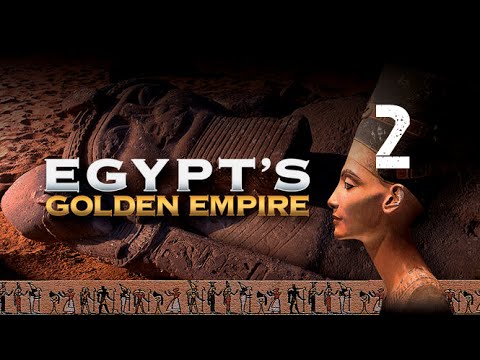
Egypt's Golden Empire


 Over 3,500 years ago, Rome was no more than a soggy marsh and the Acropolis was just an empty rock, but Egypt was on the brink of its greatest age - the New Kingdom.
There was an explosion of creativity, wealth and power in Egypt that would make it the envy of the world. After defeating the Hyksos invaders, successive Pharaohs expanded and maintained their Empire through both force and diplomacy.
In the process, they won Egypt vast amounts of gold, influence and respect. They included; Ahmose, Hatshepsut, Tuthmosis III, Amenhotep III, Akenhaten, Tutankhamen and Ramesses III. Behind the power of the Egyptian empire lay a vast wealth of natural resources.
Chief among these was the river Nile, the freeway of the ancient world, whose floodplains also provided huge expanses of fertile farming ground that kept Egypt self-sufficient and usually famine-free. Along the banks of the Nile, the humble papyrus plant was used to create a bureaucratic efficiency and cultural sophistication previously unknown to mankind. Episodes: 1. The Warrior Pharaohs, 2. Pharaohs of the Sun, and 3. The Last Great Pharaoh.

Lion, I just saw on another documentary where Dr. Hamas stated that Khafre was the face of the sphinx.
how can i view this when i just saw COBS OF CORN??
Any one who has ever taken an entry level Egyptians studies class knows that the original dynasties in Egypt were African/Black. There is no debate about it. Check out a text book at your local college.
Pharaoh (white house- Per Hetch) can never have more importance than KING. Stop the deception
Sequenenre Tao, father of Khamose and Ahmose was betrayed by one of his priests and killed by Hyksos in the temple. The betrayer was found out, put to death and placed in the tomb with Sequenenre Tao. That was the reason for the war. 18th vs 14th dynasties.
cut it out the egyptains were black and az we know black come in a varitry of shades trer not arab wich are white people pal arab
Why did the documentary keep showing corn as their crop?
Corn is from the Americas, Egyptians wouldn't have had corn
in Bible prophecy Egypt it symbolic of the fallen world towards the end of time..starts of decked in, fame, riches, pleasure, ease and glory and ends, well, you know as God says in ruins never to rise again.interesting stuff
This was great watch.Really enjoyed it a lot!I am also very impressed by the knowledge of Egyptology and history in the comments!Astonishing!It's renewed my interest in Egyptian studies.3000 years of Pharoahic dynasties is an overwhelming subject.
I don't like how they painted the picture of the nubians being of a different race than the egyption pharoahs. egypt was an all black land hence the term unification of "upper and lower egypt", not nubia and egypt, they r one land and of one people. However the hyksos was the invasion of those from the north or "whites". And the footstool that depicted the blacks as being steping stones to me seemed out of place. Number one the color was perfect as if it was painted yesterday, but everyother depiction of art is all faded and a distinct brown. Man times in these docs you can finf some truth along with alot of misleading info....I'm not biased but the facts r facts and it should be stated at that. and oh yeah it is well known that the sphinx represents tefnut the lioness......
lol @ Karen.
no... just no...
@Thomas
Ha! Not just South American corn in ancient Egypt. Seems they had vacinations by needle in ancient Egypt too - if the scars on the arms of the ladies in the re-enactments are anything to go by.
hm... I didn't know that the egyptians of 1400 B.C. already had corn... the things you learn in documentaries are 'interesting' to say the least.
I'm pretty sure that Cleopatra was the "Last Great Pharaoh" and even if they did mess up on that they should have at least messed up by saying King Tut.
P.S. Cleopatra was Greek and Macedonia, but she loved Egypt so much that she just took the culture and the language as her own (I think I read somewhere that she was the only Pharoah to speak Egyptian:] ). And Lion, if you did study under the wonderful Dr. Hawass, I am truly jealous.
Tutankhamen was an insignificant king. In his tomb, nearly none of the treasure found was actually his. His sarcophagus was, it is believed, actually in the image of his father. as was the majority of his treasure. People make such a big deal out of him only because his tomb was not ransacked.
The sphinx was built by Djedefre in the image of his father. Up until recently, historians believed Djedefre to be an outcast, that he murdered his brother in order to obtain the throne. However, recent evidence has come to light showing that he was in fact a highly revered king, and that he did nothing against his family.
(This information comes from a studying Egyptologist. I have my masters degree in archeology, and I have studied under Dr. Zahi Hawass.)
The Sphinx was female? Really? And does it really matter? The Sphinx was and is a big rock... nothing more.
i noticed in one of the videos that someone found tablets that was inscribed. i wonder if the tablets that had the inscriptions was inscribed so to be protected from water or air damage. and i wonder how long the inscribed tablets were in the sand before found.
i have watched many shows about egypt but not all the time. it is very interesting to know about the past. i recently seen a documentary about genghis khan and i know that he visited egypt. the documentary was about a map that they had found and on it was everywhere he had conquered. when they showed the map it showed that africa was under water mostly in the center of the whole place. anyways everytime i see the pyramids they look as they have been eroding. theres one thing though i had this dream about the pyramids that enlightened me very much but that is my secret since that dream i believe the egyptians had much more and something bad happened to the land. i don't believe in god or anything but the dream i had was very real and i think that there is much more to that place than people think. all i know is that so much is being translated from writings but two words have more than one meaning. it could all be misenterpreted the only ones that know the truth are the families that don't die in the place and pass the word from generation to generation. someone knows.
baba - Moses probably isn't mentioned as very little, if any, of the Exodus story or later conquest of the promised land is mentioned in Egyptian records, or those of other surrounding kingdoms. This is a series about the Egyptian Pharoahs of the New Kingdom, not the Torah/OT or the mythistory of Israel. If Moses did exist, we don't know which Pharoah it would have been, as estimates for the time of the exodus differ by hundreds of years (if it actually happened).
Just to add another reason to the list of why Cleopatra was not mentioned - this is a series about the New Kingdom. Which was over 1000 years before her time.
Where is Moses -the prophet- in this, he wasn't mentioned in the story, according to my calculations he lived about 1200 years before Jesus christ, that would put him in the times of Rames the second- the great- but that one died old,95 years old, not in sea, I am just wondering don't wanna offend anybody. The biblical story is not written on the walls of the Pharaos, could that be possible.
GREAT doc and the music is SUPERB!! I wonder where could i get the music??
>How come all these Egyptian films negate the fact that this was a matriarchal society.<
Because it wasn't. There is no proof - absolutely none whatsoever - that Egypt was a matriarchal society. Indeed, all available evidence indicates exactly the opposite. If you care to educate yourself and examine the evidence, I recommend reading any of the following monographs. The heiress theory has been thoroughly debunked.
Mertz, Barbara. "Certain Titles of the Egyptian Queens and Their Bearing on the Hereditary Right to the Throne." Chicago: University of Chicago, 1952.
Robins, Gay. "A critical examination of the theory that the right to the throne of ancient Egypt passed through the female line in the 18th dynasty." Göttinger Miszellen 62 (1983): 67-77.
Troy, Lana. "Patterns of Queenship: in ancient Egyptian myth and history." BOREAS 14. Uppsala: ACTA Universitatis Upsaliensis, 1986.
Moving on to the documentary itself, I thought it was excellent. The reenactments were a bit amusing, as always, but the information itself was mostly correct and presented in an interesting fashion.
Actually Cleopatra VII Philopater was Greek and not Egyptian. She did rule Egypt as a Ptolemy though, her daughter Cleopatra VIII Selene was the daughter of Mark Antoni and therefore half Roman and she did not rule Egypt at all. She was Queen of Cyrenaica and Libya and married Juba II and they were given Mauretanian to rule by Octavian, later Caesar Augustus, who defeated her parents and caused Cleopatra VII to commit suicide. FYI Cleopatra VIII was given to Octavian's sister and Mark Antoni's ex-wife, Octavia Minor, to raise after her parents death. Her second name means moon as her fraternal twin brother Alexander Helios means sun. And we thought our family relationships were complicated!! So that is why the documentary mentions only three Egyptian Queens as the later Queens were Ptolemic and therefore Greek, at least that's what I think. Loved the documentary, I saw one episode on TV years ago and loved being able to see all of it here online. :)
Very good doc. series. Lucky King Tut was an outcast or his tomb would have been raided too and everything lost like the others.
Cleopatra was a mistress to roman emperors, who were the real rulers, and the great Sphinx of Giza is the (male) Pharao Chephren (Khafre). The Sphinx with Chephrens face symbolise the Sungod, or the son of the Sungod. It's the greek sphinxs that often are female.
Ok. Add this to my list of the many "to watch" docs here. You forgot Cleopatra. Wasn't she an Egyptian powerhouse too? Was she mentioned? I suppose now I'll just have to watch this doc to answer my own questions.
How come all these Egyptian films negate the fact that this was a matriarchal society. Women were revered and had power as evidenced in the origin of Egyptian words, still spoken to this day. They were not mere figure heads with limited power as our queen is. But yet the narrator characterizes the time as a 'mans world' in his own patriarchial point of view. So, Queen Nefertiti dies, the whole city crumbles, I guess we know who was really in charge, and that the Pharaoh was just the figure head. What was the experiment, oh yeh, that males and females were equal. Failed miserably, without her he was nothing and worse--despised.
This film makes you wonder if one of the 3 queens mentioned owned the face that was originally carved and adorned the sphynx. Yeh, that's right! The sphynx is a female. A lioness, the hunter.