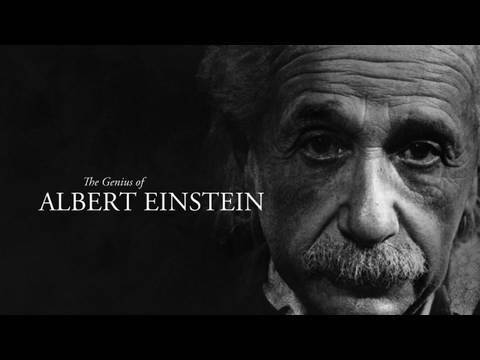
Exploring Einstein: Life of a Genius


 One hundred years ago, Albert Einstein changed the world with four papers that led directly to the development of atomic weapons, space travel, satellite technology and a profound understanding of the universe.
But, wracked with guilt over the real - world applications of his science – specifically, how the use of atomic weapons clashed with his religious beliefs – Einstein spent the last half of his life desperately trying to disprove the implications of so much of his work.
Learn how the greatest scientist of the 20th century would spend his final years enduring appalling professional humiliation. While most of the world hailed him as a genius, he slowly became a marginal figure within the scientific community – revered, but ignored. And it was all because he could not accept the fact that his life's work stood at odds with his personal beliefs.
You don't comment on this...But, General Relativity and the Theory of the Laser....entirely Einstein's....
You're a CON artist ...and I highly recommend you get your dumb act together...
Even today there is hatred and jealousy of Einstein....and we certainly know why....
Don't disagree with Einstein just to make yourself feel smart. Einstein's theories were accepted because all of the scientific minds at the time tested and failed to disprove Einstein. They weren't ramblings of a mad man. That was proven when he was right about the eclipse. He also theorized the Einstein-Bose condensate which has been created about 70 years after he "theorized" it and guess what? He was RIGHT.
i think it is disappointing when the film makers obviously had access to some rare early footage and to some close collaborators intermingled with various bits of bowie talking as well that they still managed to skim over the actual content of most of his work and equally make some serious omissions along the way 'the man who sold the world' for example except to say 'here bowie wore a dress on his next album cover...' there was no attention payed to any of the live albums or infact the 'heroes tour...' at times there was a mish-mashing and compression of chronological information and album releases... 'lodger' also got lost in there -as his end piece to the 'berlin trilogy' of 70's albums that he made with brian eno- i dont think we need another puff piece about bowie i think there is a real opportunity now for an exploratory documentary of a massive body of work and the creator at the centre of that... this film made me at least imagine with my square eyes 'what if...' what if a great documentary filmmaker historian did an in depth study of our alien father as he stood through the second half of the 20th century and beyond... what if they had the budget and the person to make a hbo or a pbs 6 part series - now see how square my eyes are... it seems apparent to me that as early on as the name change to bowie and the release of 'space oddity' we have this integral questioning of the construct of self and the identity of character whether thats in this song or one about dylan or warhol or himself or a myriad of invented characters along the way who become fuel for the flame... i am of the school of thought that says bowie disappeared after the release of 1980's 'scary monsters' album and didnt start to reemerge again until the release of -his wedding album- 'black tie white noise' and then fully came back into being with his character explorations and miniature plays on the album 'outside' and since then 'earthling' 'heathen' and 'hours' all hold good qualities... i think that 'reality' wanes as another attempt to launch a world tour and audience though... i am ever hopeful after all this time -the years are mounting- that there may be another good recording to come...
if space time can bent, how can i make a 3D picture of the space-time??
just a thought, If the suns mass in space is causing a sort of dent of whcih all planets now are in its gravitational pull.
wouldnt are view of the sun be obstructed even slightly?on top of the dent in space provoed by the sun, what about the dent provided by the other plaets earth included, if we are like a pond that ripples when a stone is thrown, the views of all the planets and the sun should in fact be obstrucuted.
"The kinetic energy increment could increase the mass only if it were actually converted to mass by some appropriate process, and in that event it would cease to be kinetic energy; that is, the corresponding velocity would no longer exist. Actually this hypothesis of Einstein's is inconsistent with his concept of the conversion of mass into energy, regardless of the point of view from which the question is approached. Mass cannot be a by-product of kinetic energy and also an entity that can be converted into kinetic energy; the two concepts are mutually exclusive...
This hypothesis was formulated as a means of accounting for the otherwise unexplained decrease in acceleration at very high velocities (in particle accelerators), but in the system now being developed from the Fundamental Postulates this phenomenon is found to be due to the vanishing of (the electro-magnetic) force as velocity approaches unity, rather than to any variation in mass". (The Structure of the Physical Universe, Chapter XXXII)
"In astronomy the currently accepted ideas are almost completely wrong, because of the strangely unquestioning acquiescence in Einstein's assumption that the experimentally observed decrease in acceleration at high speeds is due to an increase in mass, and that speeds in excess of that of light are therefore impossible.
...As has been demonstrated in the course of the development of the theory of the universe of motion (The Reciprocal System of Theory), the speed of light is a limit applying only to one-dimensional motion in space, and there are vast regions of the universe in which motion takes place in time, or in multi-dimensional space. Most of these are inaccessible to (sensory) observation from our position in the universe, but some of the entities and phenomena of these regions do have observable effects on the material sector (Pulsars and Quasars), the sector in which we make our observations". (The Universe of Motion, Chapter 10, )
Tesla statement on Einsteins theory:
"Stating that the Einstein theory is erroneous in many respects, Dr. Tesla stated as early as 1900, in his patent 787,412, that the current of his transmitter passed over the surface of the Earth with a speed of 292,830 miles a second. According to Einstein the highest possible speed is 186,300 miles a second.
Tesla indicated knowledge of speeds several times greater than light and had apparatus designed to project so-called electrons with a speed equal to twice that of light.
Tesla disagreed with the part of the Einstein theory which states that the mass of an object increases with it's speed. The mass of a body is unalterable, contended Dr. Tesla, according to the article, 'otherwise energy could be produced from nothing, since kinetic energy acquired in the fall of a body would be greater than that necessary to lift it a small velocity'." (The Literary Digest, November 7th, 1931)
"Mass and Energy differ only in dimensions; that is, energy is the reciprocal of one-dimensional velocity while mass is the reciprocal of three-dimensional velocity. This mass-energy relation does not mean that a quantity of energy always has a certain mass associated with it; on the contrary it indicates that reciprocal velocity exists either as mass or as absolute momentum, or as absolute energy, depending on the effective dimensions, not as all three or any two simultaneously. Mass is equivalent to energy only when and if it is transformed from the one condition to the other and the mass-energy equation merely gives the (theoretical) mathematical equivalents in the event of such a conversion.
In other words, an existing quantity of energy does not correspond to any existing mass but to the mass that would exist if the energy were actually converted into mass. For these reasons Einstein's hypothesis of an increase in mass accompanying increased velocity cannot be accepted". (The Structure of the Physical Universe, Chapter XXXII)
Tesla also debased einstein's notion of an "increase of mass" due to acceleration in the following statement: "The kinetic and potential energy of a body is the result of motion and determined by the product of it's mass and the square of it's velocity. Let the mass be reduced and the energy is diminished by the same properties. If it be reduced to zero, the energy is likewise zero for any finite velocity." (New York Sun, July 12th, 1937)
1878 – James Maxwell in Scotland publishes Special Theory of Relativity in Encyclopedia Britannica which Einstein publishes as his own in 1905 without citing Maxwell
1888- Heinrich Hertz publishes his paper on the photoelectric effect, a paper which Einstein failed to cite
1898- Poincare in France wrote the paper on the theory of relativity, which never mentions Einstein, which Einstein plagiarized as one of his 1905 papers without citing Poincare
1900- Max Planck and Wilhelm Wien of Germany develop the quantum theory which Einstein plagiarized as his “Light Quantum” paper in 1905, citing neither Planck nor Wien
1903 – Olinto de Pretto publishes E=mc^2 in Atte, a scientific magazine known to be read by Einstein, which he later claimed as his own work and which he failed to cite
1904- Friedrich Hasenohrl of Germany, citing J.J. Thomson of England and W. Kaufmann of Sweden, publishes E=mc^2 in same journal as Einstein plagiarizes as his own in 1905, failing to cite any of the three
1905-Philipp Eduard Anton von Lenard, whom Einstein’s wife studied under, received a Nobel Prize for discovering the photo-electric effect, which Einstein plagiarizes the SAME year has “his” paper, with no reference to Lenard
@NotSoFastMrJew
You show ignorance openly wrt Einsteins works. If you haven't had any basic Physics, don't even open your mouth. First of all Einstein was not given Nobel Price for Relativity Theory for which he should have won definitely. He was awarded Nobel Prize for his work on Quantum which was experimentally verified. On top of of stupidity, 1/2 that prize money went as alimony and the remaining half as charity. Nothing is too late to start learning.
If one reads Mileva, her brain is nowhere near Einstein's. Trajedy is all non-Physics guys are commenting on Einstein as if they are experts in Physics/Mathematics. The man behind Einstein's Mathematics was Marcel Grossmann. Einstein wasn't an expert in Math although ppl those days considered him as a Mathematician! So, he asked for a Mathematician who could help him convert his physical ideas into Math. This help is only true wrt his General relativity theory.
What's your degree? Go and get some education. Pray God gives you some brain...and stop writing nonsense.
As a general remark Einstein didn't agree with the conceptual ideas on which QM was based. Any scientific theory can be disproved by some other scientist after couple of yrs or decades or centuries. That's why its called 'research'.
Close, no cigar. The REAL title of the book is The Manufacture and Sale of Saint Einstein. I guess I got a little dyslexic with the title.
First it was Archimides wife (dumb joke) now your telling me that Einsteins 1st wife Mileva Maric was the brains of the operation!! Next you will be telling me that the queen of England is a woman, ah, well, you know...
It's really dissapointing to find out that Einstein was a mysogynist and horrible to Mileva. I have only read excerts as i can't find the free pdf.
can anyone link us to the free copy of 'The unexpected Einstein: The real man behind the icon' by Denis Bryan?
@NotsoFastMrJew:
Am no expert but it seems to me you dont particularly like jews. Now now that isnt very nice, is it?? Einstein deserves the credit he gets. Maybe his former wife does to??
I'll let Albert answer for himself:
"Only two things are infinite, the universe and human stupidity, and I'm not sure about the former."
Albert Einstein
Albert Einstein = Zionist Fraud
There is a free to all, 1200+ page pdf internet book regarding the real Einstein. If this is your hero, you should at least know who he is. For example, because Einstein was a big supporter of Zion, Jews insisted he be given a Nobel Prize. Since Einstein was a purely theoretical scientist, he was never eligible for the prize to begin with. Nobel made it very clear that the prize was only for those conducting demonstrable, experimental science. Further, Einstein was known for presenting other scientists work as his own and he as much as admitted this during his life time. The theory of relativity was not his idea nor did relativity have anything to do with the subject of his Nobel Prize. Regardless, Einstein was required under the conditions of the Nobel Prize to give a speech on the subject of his Nobel Prize and he gave his speech on relativity as if his Nobel Prize was for the theory of relativity (which it clearly was not, look it up). The Jew controlled media continued on with it as if he really did receive a Nobel Prize for relativity.
There is also evidence to suggest his former wife was the one behind his elaborate mathematics. Einstein gave all of the Nobel Prize money to his former wife (and E. was well known as a Jew when it came to money, read "cheap skate"), a move that Einstein spent large amounts of time and money to conceal. Also, Einstein was never known for his elaborate mathematics after his split with this particular wife.
So, what do you know? The Jews have lied again.
The conclusions reached in the summary above are garbage.
Yes je was unhappy about his role in the initiation of the Manhattan project but he was NOT wracked with guilt about his scientific theories in any way. The summary mixes his personal life with his theoretical life in an entirely wrong-headed manner.
And today there is a recognition that he was almost certainly on the right track in his search for a grand-unified theory of physics, though he simply didn't have the necessary scientific research available upon which to base it (comprehensive high-energy physics, cosmology, dark matter and energy, the cosmic background radiation, and some modern maths).
It's true he never yielded completely to the findings and implications of modern quantum theory, and he was almost certainly wrong in that particular stubbornness (see Bell, Aspect, et al), but he still served as an extremely effective devil's advocate in forcing quantum theory to heights of discipline and articulation (see Bohr).
Or, as Einstein himself might characterize the summary-writer, "He's not even wrong".
- Greg
Hi,
Does anyone know the name of the aria at the very beginning of part one?
Thanks
Hi
At the very end of Part 5 of "Exploring Einstein, Life of a Genius" ther is a black and white image if Einstein.
I can't seem to find it anywhere.
Any ideas of where it can be found and saved for future printing
Thanks