The Trial of Saddam Hussein


To see Saddam on a trial was something that Iraqi people couldn't even imagine. A former dictator standing in the well of the courtroom and being tried on evidence publicly presented for the Iraqi people and for the world to see... and to make their own judgments. That is the first step towards the rule of law. The hope was not that he would be punished, that was entirely secondary all along, but that the entire system which was beheaded would be put on trial.
The trial began in October, 2005, two years after Saddam's regime toppled. Iraq was a volatile mix of violence and politics and an insurgency, hostile to the American occupation, was growing. The US government hoped that bringing the former dictator to justice would help build democracy in the new Iraqi nation. But events outside the courtroom threatened to undermine the trial.
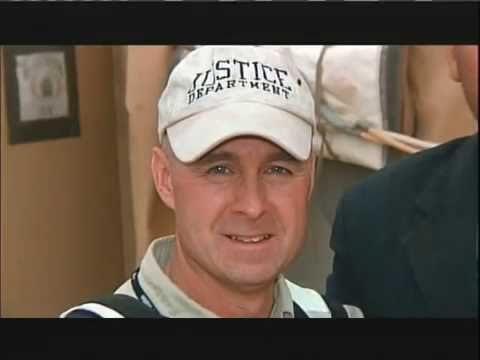
In December, 2003, President Bush's representative, Paul Bremer, and a counsel of leading Iraqis governed Iraq. They established the Iraqi High Tribunal to try Saddam Hussein and his regime. To assist the new court the US Department of Justice created the RCLO - The Regime Crimes Liaison Office - a team of lawyers and investigators.
They wanted to establish a court where for the first time people were going to be tried based on evidence presented in the court. Not like courts that Saddam had, where there would be a knock in the middle of the night, and you'd be whisked off at eight o'clock at night to the revolutionary court, tried by ten, convicted by two in the morning, and dead by six.
Investigators collected evidence for 14 criminal cases against Saddam's regime. In a desert town of al-Hatra a mass gravesite was uncovered. There were 300 bodies, women and children only, virtually all with a gunshot wounds in the back of the head. It was evidence in the most notorious case - Saddam's campaign to exterminate Kurds in the 80's.

If you're going to call it fake you damn well better have proof WTF do you think you are donald trump
The capture of Saddam was a scam. The trial was a scam. The hanging was a scam. That man was not Saddam. Open your eyes people, this is obvious.
How many political leaders would be considered mass murderers or war criminals when ousted by a foreign military? All of them?
I think the WMD farce comes down to the idea that the inference by Bush that they were manufacturing WMDs with more dangerous capabilities than the weapons that America provided them with. The assertion wasn't; "Saddam still has some of those nasty weapons we sold him." It was; "Saddam is manufacturing/purchasing new and dangerous weapons that he intends to use."
Saddam was a violent dictator but the reasoning and justification for invading was false or exaggerated, resulting in an unjustified invasion, no matter how you slice it.
The picture used for the storyline is taken from the cover of the book "The Trial of Saddam Hussein" by Dr. Abdul-Haq Al-Ani, in which he explains the occupation and its aftermath and the farce of the trial. Info on the book can be found here:
Everyone is asking "where were the weapons of mass destruction?" No one is talking about the pregnant women and children that were killed. He deserved to die just based on that alone.
Curits Lemay wasnt hung, Kissinger gets a bull**** Nobel Peace Price, its all a farce controlled by the victor of the day.
f*** saddam and his henchmen
This is saddam or not. But i m condemn the way of US to interrupt in the sovereignity of any Country.
That is not Saddam.
My boyfriend grew up in Iraq. He believed at times he was on drugs probably given to him by soldiers when he was captured, This is a great one to see: Hour Zero or Zero Hour the capture of Saddam Hussein
I doubt if he (Saddam) was the real one in court. I see him much different from we use to see him on TV during the invasion. Any way no one can tell.
Obviously that is NOT Saddam Hussein - it's one of his doubles! Once one has realised that, the blather and emotion from both sides here in this documentary and this forum, seems utterly, wrongly misplaced!
Check his voice, check his facial markings, the silly beard - it ain't Saddam! This lifetime devoted double allegedly 'muttered' at his hanging 'Palestine belongs to the Arabs'. Hmnnn... The royal, educated, murderous Hussein would have deferred to death differently, in my humble opinion!
Saddam allegedly died in 1999 and his first wife and two sons ran the country using his former doubles 'till 2003. Saddam's son, Uday had a double too - Latif Yahia, though the current-day Orwellian media are doing the darndest to sanitise and dilute such uncomfortable truths.
after watching this documentary i firmly believe that democracy is not suited for islamic states which mostly function based on hatred and violence.
I can think of a few American and British leaders who could be tried for crimes of torturing people and murdering innocent people. like children. Every great nation has fallen i wonder who is next. History is made from today's news, or should i call it propaganda .
What would history really be like if it was written by the losers .
Well done history lesson. This is the kind of film to show high school students, nice and objective.
The U S lust for oil could't be the reason could it? Bush is oil and his government was full of oil associates who do what they want and tell the populace what they want also which is hardly ever the truth.
The whole trial was a s*upid circus,we should not be there they are barbaric ,and have no understanding for fair trial.they should just shoot him when they pulled him out of the hole and don't waste no time try to figure it out what he really did.It's no brainier Bush is the one who started that stupid war and invaded Iraq but of course the mass media tells us he liberated Iraq.he is responsible for all the civilians death and American soldiers but of course we don't talk about that
Perhaps it would have been more appropriate at the point where you see Sadam dangling from the rope to have a Walter Cronkite like voice over simply announce "Ladies and gentlemen, we have now officially lost the moral high ground". Of course it's very hard to feel any sympathy for the man himself, he was undoubtedly a monster, but it should be recognised that before he fell out of favour, he was our monster. Furthermore we unofficially lost the moral high ground about 60 years ago, but that's another story...
I can't believe lawyers are feeling sorry for Saddam's outcome. Come on they went to school, higher education, big bucks, ivy league, should of known. History repeats itself. Absolute power corrupts absolute.
So in order to prevent Saddam from killing innocent people we started a war that so far(!) has resulted in 200,000 dead civilians.
I understand that documentary was made in the U.S.A. by PBS but I think the American point of view was too emphasized. I don't deny it was a deeply political trial with many irregularities but there were too many U.S. advisors interviews to my liking.
always get rid of former buisness allies,right?just think of what explosive info he had to tell?
i agree, where were the weapons of mass destruction? We can't ask enough.