
Fermat's Last Theorem


 Simon Singh and John Lynch’s film tells the enthralling and emotional story of Andrew Wiles. A quiet English mathematician, he was drawn into maths by Fermat’s puzzle, but at Cambridge in the ’70s, FLT was considered a joke, so he set it aside. Then, in 1986, an extraordinary idea linked this irritating problem with one of the most profound ideas of modern mathematics: the Taniyama-Shimura Conjecture, named after a young Japanese mathematician who tragically committed suicide.
The link meant that if Taniyama was true then so must be FLT. When he heard, Wiles went after his childhood dream again. “I knew that the course of my life was changing.” For seven years, he worked in his attic study at Princeton, telling no one but his family. “My wife has only known me while I was working on Fermat”, says Andrew.
In June 1993 he reached his goal. At a three-day lecture at Cambridge, he outlined a proof of Taniyama – and with it Fermat’s Last Theorem. Wiles’ retiring life-style was shattered. Mathematics hit the front pages of the world’s press. Then disaster struck. His colleague, Dr Nick Katz, made a tiny request for clarification. It turned into a gaping hole in the proof. As Andrew struggled to repair the damage, pressure mounted for him to release the manuscript – to give up his dream. So Andrew Wiles retired back to his attic. He shut out everything, but Fermat.
A year later, at the point of defeat, he had a revelation. “It was the most important moment in my working life. Nothing I ever do again will be the same.” The very flaw was the key to a strategy he had abandoned years before. In an instant Fermat was proved; a life’s ambition achieved; the greatest puzzle of maths was no more.

Thank You prof. BRAHAMAGUPTHA, I am going to publish the third Simple and short proof of FLT using simple mathematics to say that You are one of real Mathematicians.
I am going to find a simple proof to using simple mathematics of FERMAT"S TIME. What elliptic integrals. We do not know length of an ellipse.
Rewo Nhongo' i agree with you regarding the main point that Fermat had a proof of his last theorem.Your Discussion Is great. .
c^3 =a^3 + b^3 and c^2 = a^3/c + b^3/c = m+ p/c + n + q/c where
a^3/c = m + p/c and b^3/c = n + q/c. p,q<c so that (p+q)<2c and (p+q)/c 2 but (f+g)2 so that for
(f+g+1)/c = k, f+g =(kc-1)>2. This means that no such a,b,c exist so that
c^3 = a^3 + b^3. Clearly, dividing both sides of the equation
c^v = a^v+b^v twice by c gets us to the point where c^(v-2) is not an integer for
v>2. QED . Now to say Fermat did not have the proof can not be true.
Statistics is not mathematics. I am not interested. I do believe that Fermat is generous with the correct evidences at the same time he is a amateur, not a professor.
Hi all,
I have a question for the statistical test:
If we assume that the event "Fermat really had the proof" is a random variable, what probability measure would you be able to propose for the acceptance of this null hypothesis "Fermat really had the proof":
0.00001, 0.0001, 0.001, 0.01, 0.1, 0.2, 0.3, 0.4, ..., 0.90, 0.99, 1.0
I think Fermat's last theorem and the following theorem is the same.Let x,y,z be positive integers and let h=y/x, g==z/x then the following equation
g^n=h^n+1,n>2,n being an integer,has only one rational solution g=1 and h=0.
Wait a little time,I have started the second fight.
To say the least, FLT is a recursive binomial truncate operator problem solvable in three pages. That's all. Sure, it requires inspiration but I did it. Who care? Think!
Pl.read on the internet.The Simplest proof of Fermat's last theorem,University of Kelaniya
Our proof by no means under estimates the proof of Andrew Wiles.One presented understanding alone properly, both specialized in Mathematics. I do not disclose all names.
I(with two of my students) have published The proof in an international conference which should be on the Internet.
Proof of Fermat’s last theorem for n=3.
Fermat’s last theorem for n=3 can be stated thus: There are no non-trivial integer triples x,y,z satisfying the equation
z^3=y^3+x^3,(x,y)=1 (1)
Proof of the theorem. Assume that there are non-trivial x,y,z which satisfy the equation (1).Now, without loss of generality we can assume that there non-trivial y,z>x>0 satisfying (1).
Put (1) in to the form
g^3=h^3+1 (2) by dividing the equation by x^3.
Now from (2) ,we have (g-h)[g^2+gh+h^2)=1.If g-h=d ,we have d>0 and
d[(〖h+d)〗^2+h(h+d)+h^2 ]=1, which can be written as
d^3+3hd^2+3h^2d-1=0 (3) and we know that d>0 and therefore it follows from (3) that
3hd^2+3h^2d-10 (B). Hence, its discriminant should be negative. In other words 9h^4+12h0. Therefore there are no non trivial integer triples satisfying (1). I believe now, you can prove the theorem for any n>2 using binomial expansion.
The mathematicians have made mathematics difficult.Pl.read carefully in these comments inequalities are not shown properly.
For all!
I have done my D.Sc in Quantum mechanics(Theoretical) long ago.I understood that a mathematical or any problem of our fields of study can be solved using the available mathematics at the time of problem. In this regard Fermat's last theorem was published in the 17th century.Therefore I tried last(one-proof is on the internet; A simple and short analytical proof of Fermat's last theorem.) to prove theorem using mathematics available in the 17 century. Pl. note that we have already published the proofs.I want you to challenge the world by proving this type theorem or conjecture. Wish you all the best.
Proof of Fermat’s last theorem for n=3.
Fermat’s last theorem for n=3 can be stated thus: There are no non-trivial integer triples x,y,z satisfying the equation
z^3=y^3+x^3,(x,y)=1 (1)
Proof of the theorem. Assume that there are non-trivial x,y,z which satisfy the equation (1).Now, without loss of generality we can assume that there non-trivial y,z>x>0 satisfying (1).
Put (1) in to the form
g^3=h^3+1 (2) by dividing the equation by x^3.
Now from (2) ,we have (g-h)[g^2+gh+h^2)=1.If g-h=d ,we have d>0 and
d[(〖h+d)〗^2+h(h+d)+h^2 ]=1, which can be written as
d^3+3hd^2+3h^2d-1=0 (3) and we know that d>0 and therefore it follows from (3) that
3hd^2+3h^2d-10. Hence, its discriminant should be negative. In other words 9h^4+12h0. Therefore there are no non trivial integer triples satisfying (1). I believe now, you can prove the theorem for any n>2 using binomial expansion.
The mathematicians have made mathematics difficult.
Pl,read and understand this high school level proof.
Fermat wasn't joking. Of course he had a proof rendered in terms of algebra as it stood at the time. In the years immediately after Wiles' proof was published I was working for mathematician/inventor named Herbert S. Riddle Jr., of Lake Oswego, Oregon, who was dissatisfied with Wile's proof for precisely this reason, namely, that it depended on centuries of intervening developments in math that Fermat would never know. Riddle, an MIT grad, and IEEE member , who was already mutipatented in electronic circuitry & digital encoding set to work to prove the theorem using "PERIOD MATHS" and was successful, so it appears.
Riddle's approach to the solution was simply to work to prove Fermat's Last Theorem true, by proving it true FOR THE LAST DIGIT of any possible number -- and so he called his work "Riddle's Last Digit Theorem." The proof is short, about three pages in length, and at one point he reduced it to about a page -- approximating a length that might correspond to Fermat's comments regarding the margins of his book. It's simple, elegant, and tight. I published some of Riddle's work on this in 2012,
Fermat's last theorem is a joke.Follow the proof in a different way
(z/x)^n=1+(y/x )^n and show that this is not an equation for any n>2.
i wonder if this math can help the Quantum mechanic problem using the theory of Chaos as a model for a system that uses quantum mechanical experiments to prove dynamic interpretative algorithms in programming that corresponds to micro discrete component macro visual display experiment. look at complex modulations in water drop experiments that are used for De Broglie's quantum mechanic vibrations. use these complex vibrations in reference to the dance of the universe shown in the book "The Dance of the Wu Li Masters" to see if any relativistic comparison could be derived from these two sources of data. I am trying to apply these ideas using polynomial approaches to linear Isomorphisms but use bouncing of an interactive Ping Pong games as physics model verses the falling of an apple or a man jumping off a house or a spinning carousel as Newtonian physics or Einstein did with his physics. I want to use more on hands experiments like Da Vinci using art forms.
I would love it so much that it shed some light to scientific research works to me. In economics world, finding theories, making linking chains, that must be what I should reach for.
They closed with the question of whether Fermat's solution could have been Wile's. Of course it couldn't be, but they didn't ask whether Fermat might have had another solution. The assumption is that he must have been wrong or perhaps joking but could Fermat have seen something incredibly powerful that nobody has yet realized or connected to the theorem?
God exists because the Archbishop of Canterbury says so. Fermat's Last Theorem is true because Andrew Wiles says so. Mathematics or religion? So sorry to disagree with you all guys but there you all are lauding something you do not even understand. Why? The 110 page report of the proof can be downloaded from Wikipedia, so do so, read it and then tell me if you are still impressed! The truth of the matter is that Fermat's Last Theorem is true because Pierre de Fermat proved it and stated it to be so. The truth of the matter is that the mathematicians have high jacked his glory and denied Fermat the accolade to which he is due and it's time that modern day mathematicians owned up and admitted it and redressed the balance.
The marginal proof of FLT; the theorem itself being trivial and of no mathematical import; requires nothing more than high school mathematics but that's too simple for the superior intelligence of the mathematicians who like to play mind games with their abstract mathematics called axiomatic set theory. Mathematician Laucelot Hogben said that mathematicians who loose touch with the general public risk becoming a priest hood and unfortunately that in my opinion is what latter-day number theorists have become.
So the Horizon documentary whilst it was historically correct and entertaining, was in fact a miss-sell that only served to perpetuate what must be after 370 years the longest running hoax in history!
im lost... its modual? with semitres? on another world. but its a dictionary?
"Anathema to mathematics", with that I suppose you mean empirical evidence is not applicable to math.
In that aspect math may be comparable to philosophy which also totally depends on logical evidence. Maybe that is what makes it fascinating to people like me who haven't any grip on the matter the exact sciences are concerned with.
Very nice documentary.
Although the math part is way above my head, I found it interesting because it is a cosmos of its own (a sort of parallel universe, almost) and this story shows what the imagination is capable of. My respect for the hard working scientific people continues to grow by watching this kind of stuff.
Hats off to mr Wiles and the people that helped him prove Fermat's theory.
In time I suppose unknown territories in math will be discovered and explored and new theories that cannot be proved immediatly will pop up, just like in physics and other scientific disciplines.
Dr. Wiles' proof of Fermat's Last Theorem is not only one of the most remarkable achievements in modern mathematics, but in scholarship in general--and I don't mean to leave out those who worked in tandem with him.
As a side note, the label is misleading. The handwritten comment in the margin of the book appeared early in Fermat's mathematical career and it became a theorem only after Dr. Wiles who is one of my few modern day heros was able to prove it. It is called Fermat's Last Theorem because it was the last conjecture of his which needed to be proved--and for the little that it matters, I agree with Dr. Wiles that the Judge Ferman could not have constructed a proof using the mathematics of his time.
I never cease to be amazed at the complexity behind the simple physical principle, "You can square a square, but you can't cube a cube, etc." and at the amount of fine mathematics which came out of the abortive and flawed attempts at a proof made within the last 200 years.
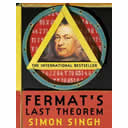
Simon Singh's book is wonderful and accessible. On the other hand, Marilyn Vos Savant's book is patently ignorant and embarassing, especially when she takes Dr. Wiles to task for using hyperbolic functions. Then she raises the boeotian question of whether Dr. Wiles' proof is valid, when indeed it has been examined and approved by at least 1,000 mathematicians throughout the globe. She seems to think that her high score on a silly I.Q. test qualifies her to go up against one of the finest mathematicians of our age.
So on to proving the Goldbach Conjecture: Every even integer greater than 2 can be expressed as the sum of two primes--now, I have an idea . . .
Its very simple, its a Mathematical equation which can have infinite solutions :)
(In other words It shows you what ever you want to see.)
The mathematical Paradox which can only be solved with another paradox leading into the same problem O.O Brilliant!
(The universe is both logical predictable and chaotic and illogical.)
Thats why the problem is so weird, it mixes the both :D
except didn't Fermat say his proof would fit in the margin of the page???
I think as a academic person myself, it has more to do with: To do / to achive something nobody have done before. Like climbing the higest mountain in the world for the first time in human history. Or be the first man on the poles. It takes the same dedication just behind the books instead of something physical.
Wow, didn't understand the maths at all. Didn't matter. To see someone almost break down to tears describing how he had a (as AA members would say) "moment of clarity", really blew me away! He knew in that moment that he had reached the pinacle of his life. Amazing that maths could be so important to someone's life! This doc just proves to me how little I understand about this world. Great doc!
Absolutely one of the most intimate looks into the struggles and successes of a very special mathematical mind . Don't feel bad if you don't understand the math. It's definitely rocket science...lol. Doesn't matter one iota because the gory mathematical details are glossed over quite nicely and the supporting CGI 3-D models are something you never really get tired of seeing. Like Hubble images.
The degree of humanity and emotion on display in this documentary is profound. You're given a glimpse into the private thoughts and emotions of a man who is obviously not comfortable with the spotlight.
In the one of the most moving scenes in the documentary, Mr. Wells is recalling the relief he felt when finally solved the final lingering problems with his proof and he almost cries on camera, brought on by a near overwhelming mixture of relief and sadness. He was happy to have finally and definitely solved the problem. The sadness and tears seemed more a product of the realization that having solved the thing that puzzled him and motivated him for decades he couldn't picture any future challenge that would excite his intellect in the same manner.
If you like stuff like this documentary, you'll probably love anything involving Richard Feynman (RIP) that you can find.
Enjoy.
@ Azilda, you have indirectly touched on a few of the fundamental and not-so-well-known themes that reccur in Mathematics. Firstly we are used to thinking that maths is boring because there is one answer and no subjective debate on any particular topic. It's either right or wrong. What is less well know is that there are many routes though any given problem some using elegant 'simple' maths and others using indirect complicated ideas drawing on many different branches of the subject and your musical analogy illustrated this idea well.
Fermat's marign proof: The margins were a lot bigger in those days! But seriously I like to think that it was a joke by the great man, he knew that it was an extremely complicated and drawn out method of reasoning and added some all-be-it unaccessible to the non-mathematition style humour. It certainly adds charm and mystery to the story.
'There is not 1 problem bar none that was thought by a human that cannot be solved.'
It has been proven by the great and admittedly insane Austrian mathematition Kurt Godel ( He of time travel to the past is possible if we can spin the universe about a point fame) that in any logical system there will ALWAYS be some ideas that are true that will be non-provable! A side lemma of the celebrated Incompleteness theorem.
A philosophically profound statement demonstating that we will never know the answers to everything. You can imagine... his ideas went down like a lead ballon in mathematical circles.
As a i wrote my previous comment i had not finished watching the movie yet. When at the end he says..."Fermat could not have this proven, it's a 20th century proof, there is no way this could have been proven before the 20th century".
I was reminded of a situation one evening long time ago. I was visiting some musician friends. There were music sheets on the table and i started looking through them, I came upon two different sheets for the melody of Bourrée. One looked very simple as if a child could have played it and the other looked extremely complicated as if only a master could read and play such intricacy of music. I asked my friend to play Bourrée from the two different sheets alternatively so i could hear the difference. He played it on the violon, i must say to him they were very different but to me they "almost" sounded exactly the same.
So could it be that Andrew Wiles found the intricate way of explaining something that Fermat could explain in a very simple way?
I don't know...as i wrote under this comment....i am no mathematician, i am a simple person who believe that the infinitely small has a perfect companion in the infinitely big!
Great doc!
There is not 1 problem bar none that was thought by a human that cannot be solved. I am tempted to think the reason for this is simply because all problems immerge from a oneness within that wants us to discover every Thing.
If i was forced to erase the life i have lived and was offered in exchange to relive only a different one, i would come back as a hyppie (living of and on the land) mathematician, one day gardening and one day puzzling.... on and on and on.... I believe mathematic is a completely different language, one that i do not speak a word of. Although i am not bilangual in numbers as i am in letters, i sense that mathematic talks of the unknown like nothing else.
My mind can think in very magical ways but my mouth and fingers can't and i believe if i could speak math i could do magic.
I may still find the path a different way, i will never cease to search because this is the life i live and i love it!
az
Fascinating! I loved this video. As a child I also was fascinated by Fermat riddle. I wonder if Fermat really had a proof...
Great!
paul,
Before I move on to the main content of my comment, are you the same Paul who wrote comment 2?
Forgive my ignorance here however, what is a "libro"? Most of what you wrote went well over my head. The one exception was what you said about Onofrio Gallo (I confess I have never heard of him but I do not mix in mathematics circles). You write that he obtained a direct proof in 6 pages. I'll confess again, if there is a technical distinction between direct and indirect proof, I am not aware of it. With my layman's definition, I can see how the Wiles proof is indirect with the incorporation of a number of branches of mathematics.
Key question: if Onofrio Gallo had already solved it, why did Wiles attempt it? As the documentary shows, it took Wiles years - and sequestered away. From what I saw of the documentary, it seems that mathematicians who operate at this level are intimately familiar with what the other is doing. Hard to imagine that Gallo's proof would go unnoticed - especially given the history of the problem since Fermat first proposed it. As a layman, I am aware of the Wiles breakthrough. I still remember seeing it on the news back in 1993 and talking to people about it. Gallo is a man who, as I said, I haven't heard of.
Tom.
PS. I am the same Tom who wrote comment 4.
About Simon Singh and his book Fermat's Last Theorem. This is a nice libro.I think however, that its continuation will soon be written somewhere else (or the same Singh, who knows?) and, paradoxically, seems to be starting all over again. As I understood before indirect proof of
Fermat's Last Theorem by Wiles and Taylor there was that of the Italian mathematician Onofrio Gallo (b. in Cervinara, Caudina Valley) who has obtained a short original proof(6 pages) and in a direct way .It seems to be the only direct proof currently existing.But the most surprising thing is that Fermat's Last Theorem is a special case of the so-called MIRABILS THEOREM OF GALLO (December 27, 1993, Rome) based on a theory even more surprising and original (glimpsed just by the French mathematician E, Galois) that manages to combine an equation to an identity in a non eucledian logic. Paul
respect
@gotama
re: doughnut maths
hmm
Wondering if the Extra Long Gotama Sugary Apple Doughnuts Are The Best Theorem linked to the Baker conjecture, 12+1=dozen...
@toodance
Glad to relieve the tip of the ear problem with T.Rex! And I have a proof that Sugary Apple Doughnuts are the best, but its too large to fit in this comment box...
@gotama
lol. glazed or cake
T.Rex thing drove me momentarily mad after I read the inquiry. awesome fetch of memory. thx
BTW for killeroftime, the song at the 8.30 mark is Metal Guru by T.Rex
I loved this. Seen it before and loved watching it again. Elliptical curves = doughnuts. I don't understand the maths, but I do love a good doughnut.
Does anybody know the song at approx. 8:30 mark?
I loved that he never gave up. -Kind of wonder if he has children. My father was absorbed in the same manner, and I never knew him. Always gone to his laboratory, or home in a chair contemplating in complete silence (not to be disturbed!).
I sense that the underlying (viscious) peer rivalry and the way universities profit from intellectual property was politely omitted from this story.
Absolutely wonderful documentary! There's no need to know anything about math to appreciate it, as I didn't understand much except for the last theorum.
A wonderful documentary about math, but especially about the man/men behind it.
Mathematics is not for the faint hearted, I'll say that much!
Loved the comment by Prof. GORO SHIMURA, "..it is very difficult to make good mistakes"!
gotta agree with John about this. it is a lovely, utterly human doc about what is admittedly a pretty hard subject. you're not hit with too many equations here, rather, one gets a sense of the monumental struggle involved, the tenacity of Wiles, the flashes of brilliance and the beauty of higher ideas.
makes me wish i was a mathematician.