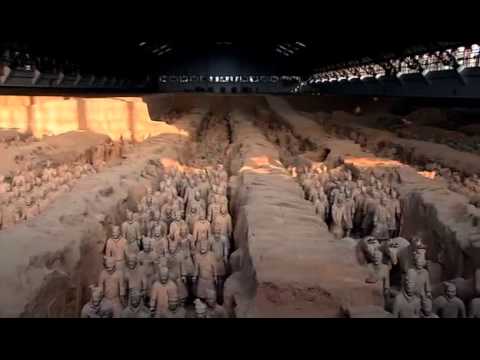
Secrets of the First Emperor
8.02


Ratings: 8.02/10 from 56 users.
 In the early years of anno domini, China experienced one of its most formidable and brilliant rulers in the personage of Qin Shi Huang, or 'The First Emperor of Qin.'
By all accounts a visionary, Huang is now credited with laying the groundwork for the Chinese empire, setting forth the plans for the Great Wall (the first ruler to do so) and establishing the largest burial site on Earth – a site guarded by an “army” of 7,000 terracotta soldiers.
This program explores Qin Shi Huang’s life and impact on successive generations, with a wealth of CGI animation and dramatic reenactments.
It also depicts the ways in which a man whom many regarded as a walking terror could paradoxically qualify as one of China’s greatest benefactors.


I like that you can respect something, such as the presentation/documentary on the Chinese Emperor, although you do not believe in the morals or justification. Not many can do this. So I thank you for being a flexible person, even just a bit. :)
In an attempt to answer your question, I would like to point out that - although it seems as unnecessary - the brutality of the ancient world was justified. Unlike in today's world, where order reigns in chaos from past experiences and modern restrain, the ancient world was still developing and trying to figure things out. Thinking in terms such as this, it is understandable that war, brutality, violence, and bloodshed was a natural - almost everyday - occurrence.
As for why we, as the modern day humans, keep retelling the ancient stories such as the Chinese Emperor, it is for many reasons. One being that we wish to remember where we, as humans, came from; where the human race has been, what they've done, how far they've come (from chaos to restrained). But the biggest reason is because, in most cases, it is these kind of men/women/people that we have to thank for either our freedom, the saving of our lives, the chaos being controlled, the path to where we are now in life, and etc. I know it can be hard to imagine sometimes, but brutality and violence can create peace and order.
And lastly, you asked about how two nations, who had no contact, could use the same term such as Emperor. Let me say that these two nations, Rome and China, had trading contact; so to think that they had absolutely no contact is a misunderstanding. But the real answer to your question is that the Roman Empire never, ever, used the term Emperor. It wasn't until later, when Latin was translated to English that the title of 'Emperor' was used for the Romans. The title was translated from the word Imperator, which means authority (more specific, authority over the army, not the State). The title for the Emperors of Rome, in which they themselves used for their positions, was princeps (first person) and more officially, Augustus (revered one). As I am more informed about Rome, I am not an expert on Chinese matters. However, 'if' the Chinese actually had a word that meant Emperor in the ancient days, I would say that it would not be like Rome at all; if they didn't have the word for Emperor back in those days, then it could simply be a translation issue, such as that in Rome. Either way, your answer is that they aren't the same and the title is merely a facet of present-day terminology.
Hope this helped!
In respect
At least they didn't go full Crouching Tiger and left the wire acts out of it so I guess I have to give them that. Have fun watching a Chinese soap opera with a bunch of LARPing thrown in.
Interesting documentary except for the over-dramatized dramatizations that look like they have less to do with historical fact that trying to make an exiting b-movie version of all the chines epic "historical" movies coming out of China in the last few years.
Would the future emperor of China be rolling around on the ground alone in battle surrounded by his enemies until he was the last one standing? Would he personally lead the charges after giving an impassioned speech that seems to have more to do with the movie Braveheart? I don't know but it seems more likely that he would be sitting on a hill overlooking the battle without being physically involved at all.
The accounts at the time tell of what a great warrior he was? The accounts were written by who? Paintings at the time showed Napoleon's great victory at Acre which in real life he lost.
The documentary would have been a lot better if they just toned down the emotional dramatazations and focused on historical accuracy.
Quote from the documentary: "The king is dead. Long live the king."
wow!! the chinese invented english
@wq I agree with you completely except on one point. I feel that MLK's sins or personality flaws will most likely not be talked about even a hundred years from now because America desperately wants to believe that the problem of race has been completely solve. In fact, we would like to pretend that the problem of race is no longer relevant in modern day society. I believe that until we deal with the issue of race and our issues with it, MLK will continue to be held up like a godly figure. It is very important for us to remember, though, like you said, that every person has many sides and what we may gather from their outer appearance is seldom who they are in every aspect of life.
@ infinity
It's because historians are better at seeing the whole picture than just the good or bad aspects that we continue to talk about the positive aspects of "despots".
There is a tendency among people (I think it's actually a neurological imperative) to believe that a "good" person is 100% good and a bad person is 100% bad. If you saw a person do something you thought of as bad (even if it's not a crime), you're inclined to believe that person is immoral in every aspect of his life.
We honor MLK but no one mentions his vices, such as the fact that he's a serial-cheater. We prefer to only focus on his contribute and label him as 100% good. Historians a hundred or so years from now will paint a fuller picture of him and talk about both his + and -.
Conversely, Qin Shi Huang actually did a LOT of good for China. I will not say his contributions outweighed his sins but he's such an important person in Chinese history, indeed world history, that it is IMPOSSIBLE *NOT* include him in the annals of history. For history to be accurate, we can't choose to only focus on his crimes nor can we ignore his contributions.
I agree with Bre, The man and heselton here...definitely some valid points from all three.
@gabriel porras
I think the idea that we've been able to build truly better societies and avoid the crimes of the past is a romantic falsehood. The level of our technology is raised providing better health care and scientific understanding, but in the worlds modern societies the rulers are no less barbaric and deluded than Qin Shi Huang. Where his dream was a wall to complete and seal his empire/power(hold over the people), the modern hidden emperors(central bankers) constantly push their dream of sealing their position through the orchestrated butchering and modern slavery of the underdeveloped countries and the intellectual rape of the now mindless masses in so-called 'developed' countries. Manufactured from purposely poor public education and an inescapable and desensitised mass media, these social, environmental and physical damage our rulers are responsible for outweighs anything Qin Shi Huang wrought on the world. At least the goal his sought was in full view of his people and the end result could actually stand to protect them^
civilization not civilisation! we don't want to follow the crimes of the past. therefore, we need to know what happened, so we can build better societes.
I also see when looking at the so called great accomplishments of certain dictators or emperors and such,,, not the greatness of such feats but the incredible pain and suffering of those forced to do these things,,, and as incredible as say the great pyramid is look at the horrible suffering of thousands of untold people suffering for one man that had a selfish dream
Terrible. Full or mistakes and inaccuracies. The dramatization was also cheezy.
Bre and Infinnity
I personally think the continued celebration of historic figures like Qin Shi Huang can be attributed to there being little historical record of individual, everyday people. The only stories/records/monuments that survive were made for the elite classes because they were the only ones who had the power and influence to bring them into being. This is not saying that we don't know what a peasant's life in China was like 2000 years ago but just that we wouldn't know much about individual stories. We can only make up a generic picture to put them all in but people like the emperor would have had all the important moments of their life chronicled. Makes for an easier documentary to produce I would imagine.
Either way it was a great documentary thanks so much for this site!
Infinity,
I like that you can respect something, such as the presentation/documentary on the Chinese Emperor, although you do not believe in the morals or justification. Not many can do this. So I thank you for being a flexible person, even just a bit. :)
In an attempt to answer your question, I would like to point out that - although it seems as unnecessary - the brutality of the ancient world was justified. Unlike in today's world, where order reigns in chaos from past experiences and modern restrain, the ancient world was still developing and trying to figure things out. Thinking in terms such as this, it is understandable that war, brutality, violence, and bloodshed was a natural - almost everyday - occurrence.
As for why we, as the modern day humans, keep retelling the ancient stories such as the Chinese Emperor, it is for many reasons. One being that we wish to remember where we, as humans, came from; where the human race has been, what they've done, how far they've come (from chaos to restrained). But the biggest reason is because, in most cases, it is these kind of men/women/people that we have to thank for either our freedom, the saving of our lives, the chaos being controlled, the path to where we are now in life, and etc. I know it can be hard to imagine sometimes, but brutality and violence can create peace and order.
And lastly, you asked about how two nations, who had no contact, could use the same term such as Emperor. Let me say that these two nations, Rome and China, had trading contact; so to think that they had absolutely no contact is a misunderstanding. But the real answer to your question is that the Roman Empire never, ever, used the term Emperor. It wasn't until later, when Latin was translated to English that the title of 'Emperor' was used for the Romans. The title was translated from the word Imperator, which means authority (more specific, authority over the army, not the State). The title for the Emperors of Rome, in which they themselves used for their positions, was princeps (first person) and more officially, Augustus (revered one). As I am more informed about Rome, I am not an expert on Chinese matters. However, 'if' the Chinese actually had a word that meant Emperor in the ancient days, I would say that it would not be like Rome at all; if they didn't have the word for Emperor back in those days, then it could simply be a translation issue, such as that in Rome. Either way, your answer is that they aren't the same and the title is merely a facet of present-day terminology.
Hope this helped!
In respect,
Bre
I liked the documentary, well done with good dramatizations, but why do we as a culture/species glorify history's mass murderers and despots? Why do we continually tell and re-tell their stories? Their contributions to "Civilisation" are dubious at best, downright evil at worst. Centralisation of power and descision making, the standardization of weights and measures, the standardization of writing systems, the codification of ever increasing laws are always held up as "benefits" gained. All of these things have served to further enslave the common man, not empower him.
Can anyone tell me just how the concept of Emperor apparently spontaneouly arose in two very different parts of the globe, amongst two very different peoples, who supposedly had no official contact? mmmmm? Rome and China?
Enough waffle.....