Why We Fight


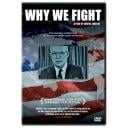 In 1961, as Dwight D. Eisenhower gave his final address to the nation before leaving the office of President of the United States, he warned that America must guard against the acquisition of unwarranted influence...by the military-industrial complex. Nearly 45 years later, as the United States finds itself waging a war in Iraq for reasons that seem increasingly unclear with the passage of time, Eisenhower's statement becomes all the more pertinent, and the question becomes more apt: has the machinery the United States established to wage war helped prevent conflict, or has it done more to inspire it?
Documentary filmmaker Eugene Jarecki offers an in-depth look at how the United States has readied itself for battle, and why and how the nation goes to war in the film Why We Fight. Named for Frank Capra's famed series of Defense Department films (which explained the motives behind America's entry into World War II), Why We Fight features interviews with foot soldiers, Army recruits, Pentagon personnel, decorated veterans, members of Congress, national security advisors, top military strategists, and many more as they talks about the core philosophies of American military strategy and how they have changed since the end of the Second World War. Why We Fight received the Grand Jury Prize at the 2005 Sundance Film Festival.


Why are there films here we cannot watch? I visit this site with less and less frequency. And some of the docs, "for preview only" are quite old. We should be able to view it here, then buy it elsewhere to support the creative process, the info and knowledge sharing.
I'm former Marine. 1975-1979... Jimmy Carter era. I've worked and lived (with family) since then inside the "military/ industrial complex". 11 yrs in Germany and 6 yrs. Middle East. After 9/11 I was gung-ho re: Afghanistan but had severe doubts re: Iraq. After Abu Ghraib blew up in the media I knew it was lost.
I'm not worried about Eisenhower's concerns... I'm worried about the collusion here at home, here and now, to trample our Constitution. 4 Branches of Gov't now? (the politically appointed bureaucrats! Where in the Constitution does it say that EPA is allowed to make laws?) Go Broncos!
This documentary was extremely well made and persuasive but unfortunately many facts were incorrect. It is sad this movie is so highly acclaimed as the premise is strong but the evidence is weak. Casualties come from the Iraqi fighting customs of sending children into the war field and playing off American reluctance to kill a child. Videos upon videos have been shown where Iraqi soldiers used children as a human shield. The information on the accuracy of the bombs is completely incorrect as I watched this film with one of the head engineers for those bombs who had the data on their reliability. 6cm is the margin of error. Also, does no one question the bias. Ex employees, betrayed retired cops, for petes sake its written by the man who got his start by writing fictional dramas. Thing he didn't tell you is that this is yet another drama that's based on a true story but not completely factual.
We have only ourselves to blame for this mess. The whole country is at fault for allowing the monetary system to be run by corporations themselves and bankers. To allow them to abuse the system and change the game to benefit their greedy buns. This is why we have wars, famine, diseases and deaths. All of these are profitable to sick minds... and when they end up with debts they just bail themselves out. Meanwhile, the poorest of humanity continue to suffer in poverty, while the richest contemplate whether to spend their money on a $100,000 hand bag or on a $4,500,000 car. It's not just revolting, there is no single exact word to describe this. It would take all day to enlist what this is called.
This is if not my favorite, one of my favorites documentaries, its powerful, the support is really good, very well developed, the analisis helps to address US foreigh policy on decition making, it's information that can't be found easily.
This is in my top 10 greatest docs of all time. Your average citizen has only watched 10 docs in their entire life; I am not one of them, and I've literally watched hundreds on this site (thank you Vlatko!).
The beautiful thing about this documentary is that its message doesn't diminish with time. President Eisenhower's last speech as President warned explicitly against the growth of the military-industrial complex. He invented that term, and as a five star general and president of the U.S. he couldn't be more qualified to illuminate that growing reality in 1952. I'd say his warning was the result of tremendous knowledge on his part.
This doc does an incredible job of telling the story of the military-industrial complex. It is not a partisan documentary, and relies on facts instead of rhetoric. Enjoy!
this documentary should be shown in every school in america to show our young children that war isn't always about "fighting for our freedoms" and that others hate us because of our freedoms
WHY WE FIGHT (along with THE SHOCK DOCTRINE, COUNTDOWN TO ZERO, THE FOG OF WAR, TAXI TO THE DARK SIDE and THE CORPORATION) is one of the greatest achievements in the documentary medium. If I had the resources and the permission of the filmmakers I would like to film a companion piece called WHY WE SHOULD NOT FIGHT. Instead of centering the piece on the words of President Eisenhower, I would chose General Smedley Butler's anti-war classic WAR IS A RACKET as the focal points. For instance, he theorized that "the only way to smash this racket is to conscript capital and industry and labor before the nation's manhood can be conscripted," for the same monthly wage as the lowest paid soldier and that if we "give capital and industry and labor thirty days to think it over and you will find, by that time time, there will be no war." However, even if WE THE PEOPLE were somehow free to remove the profits out of war (an impossibility while the Electoral College remains to keep a stranglehold against true democracy- remember that the definition of democracy is that every vote is equal; not having electors give you the choice of just two war party candidates every four years), there is the sinister actions of the CIA that have to be eliminated as well; who are free to commit murder, treason and crimes against Humanity without repercussions under the guise of National Insecurity and spreading (at gunpoint) democracy (gangster-capitalism). I hear and read a lot of rhetoric about 'taking the country back' from the elites but almost no real solutions (Ron Paul's anti-war and pro-nuclear disarmament stance aside) at the highest level. With this in mind, I propose a simple two-step solution; first, abolishing the Electoral College (so for once in our history WE THE PEOPLE can have a free and fair election) and then a mass boycott of all the pro-war candidates (and the shameless whores for the Big Money Bandits as well) for Leader of the Unfree World. For those of you not content with our current voting system and/ or foreign policies I humbly urge you all to sign the online petition @abolishtheelectoralcollege.org and I welcome all (whether you be a voter freedom lover or a hater of the warmongers) to read my essays @campaignforliberty.org (this website was set up with funds from the first Ron Paul run for the presidency). In the words of General Butler "GOD BLESS AMERICA AND TO HELL WITH WAR!"
Jesus is our savior. Wait and see ...doesn't matter if you breath and live, you will meet him any ways. Gnashing of teeth going on big time, you know it.
I'm afraid votin Ron Paul is as naive as Obama was. You never learn. You believe in the dream but never wake up to reality. If this were a game of chess the US should leave it's bases where they are because as the neo con planners realise they're gonna need them in the coming century to secure the supply of energy to maintain US domination in the turmoil that is about to hit. Energy depletion, Climate change, Wall street's betting on Asia not America, Overpopulation. A civilisation emerges cause of it's production of excess energy - Mongols/horses, Egypt/Nile, Rome/Slaves, Inca's/Canals, British/Coal and the US -OIL. Therefore you can't have your cake and eat it too. Left wing/Right Wing - all bull****. The big game is afoot. Who will control the near future will not do so acting legally/fairly/with human rights in mind. If you withdraw your armies and don't change your uber-consumerist ways you will die as a nation within a decade. Your already on the ropes and china owns you. If it calls in the debt and you don't have the army to tell them to **** off your dead. So wake up from the dream of argueing about climate change and get with reality. Cheny/Wolfowitz/Rumsfeld were bastards but certainly not st*pid. They were playing the big game - ruthlessly. You can hang on to your ideology but the price is US blood, War and more War. Either reform your consumtion and therefore go to the heart of the capitalist project or fight on. You can't have it both ways.
You Ron paul's are as naive as the Obama's last time around. If this were a game of chess the US should leave it's bases where they are because as the neo con planners realise they're gonna need them in the coming century to secure the supply of energy to maintain US domination in the turmoil that is about to hit. Energy depletion, Climate change, Wall street's betting on Asia not America, Overpopulation. A civilisation emerges cause of it's production of excess energy - Mongols/horses, Egypt/Nile, Rome/Slaves, Inca's/Canals, British/Coal and the US -OIL. Therefore you can't have your cake and eat it too. Left wing/Right Wing - all bullshit. The big game is afoot. Who will control the near future will not do so acting legally/fairly/with human rights in mind. If you withdraw your armies and don't change your uber-consumerist ways you will die as a nation within a decade. Your already on the ropes and china owns you. If it calls in the debt and you don't have the army to tell them to **** off your dead. So wake up from the dream of argueing about climate change and get with reality. Cheny/Wolfowitz/Rumsfeld were b*stards but certainly not st*pid. They were playing the big game - ruthlessly. You can hang on to your ideology but the price is US blood, War and more War. You can't have it both ways. End uber-capitalism or continue to fight.
Ron Paul!!!
Why don't they mention who the "think tanks" work for?
a very well informed documentary with an extremely strong message to be heard and internalized by all in the west! we've been manipulated, used as pawns to achieve foreign policy goals to ensure those cold individuals within the military, weapon industry and parliaments can get rich in both money and power...things rightly belonging to the people! its time to take these precious privileges back before its too late! we have to make people understand how they've been gradually indoctrinated, that its not something they cant change and that they are not responsible, deceitful criminals in high places are and they can and will be held accountable!
lets make history people to ensure we have a safe and prosperous future!
I had the privilege of seeing this film's premier screening in New York, with the director present in the audience. After the film aired, Mr. Jarecki stood up and introduced himself as the lights were coming up, and proceeded to take questions for nearly an hour. One audience member asked how Mr. Jarecki had managed to get some of the government officials he interviews in the film to speak with such rare, and startling, candor. He attributed it to a combination of those officials' very high level of self-regard along with their perception of him as some nobody independent film director. He added, "Had I been, say, a Michael Moore, I have my doubts whether they would have been so candid in their responses."
Amazing documentary.. unbelievable...now i finally know what blowback is
There was a great documentary last night(Friday) on MSNBC called "Day of Destruction Decade of War", with Rachel Maddow and Richard Engel. It was Fascinating, Educational, Informative and Interestingly masterfully produced. It is 3 hours long and shows again next Friday, the 9th of Sept at 8pm and again at 11pm. You will want to record this for viewing without commercials. You will love it I think. It also views again on Saturday the 10th of Sept at 4pm. 3 hours. Great documentary.
Patriotism is supporting your country all the time,
and your government when it deserves it.
~ Mark Twain
Watch this and The Fiat Empire and I dare you to not vote for Ron Paul next year...
There are a lot of people in the US that get this message, sadly, we are vastly out numbered by the sheep of this nation. The governments crippling of the education system along with the self-esteem movement, have made people easily controlled. Going to take something drastic to break them out of it.
This is a good one.
Opening sleeping eyes...thank you.
To those that hate u.s. and seek revenge:
It is not just your eyes that are opening, but ours as well. Unfortunately, results will not be as swift as you like.
Whereas it is a change of this type of power and a re-introduction of our youth to critical thought that is needed, this will unlikely happen during your breaths, nor mine. Without seeing results, you are understandably emotionalized into a state of action. It is your retaliatory actions that will feed the beast even further. Retaliating will only serve their purpose, and your emotional win will be short-lived.
It is easy to force an enemy to make a move to validate one’s own moves; just as it is easy to force an ego into throwing the first punch to validate one’s own “defense.” Your retaliation is their first punch, as we have seen. Every punch you make will be spun into their “defense” – your punch IS their offense. Hope this is understood.
The best method to overcome them is to infiltrate, then dismantle, these groups with long term strategies and tactics - but that is unlikely and would require raising a youth for this specifically, which is very un-heartening.
So, we must breed critical thought that cannot be so easily swayed by the methods in place today. Not brain-washing mind you, but the ability to think and rise above a mass-mind. Teach your children to critically think, as we will teach ours.
It is our youth that will continue as is, or will neglect mass-mind methods and personal fears to help reverse these tides. All we can do is get them ready.
I doubt those that hate u.s. will ever get this message, but it is out there nonetheless.
-Gawk In
excellent documentary. great production and narration, the facts and opinions are presented well. this is among my top 5 docs i think everyone should see.
This is a wonderful documentary. One of the few that I have given out to most of my friends. Lots of well informed and well spoken interviewees. Filmed in a manner that doesn't get boring or seem overly preachy. Strongly recommended.