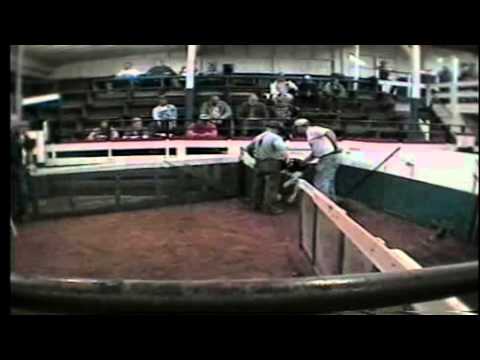
Modern Meat


 What could be simpler than a hamburger? Take a ground beef patty, throw it on a grill, wait a few minutes as the fat sizzles, maybe add some cheese, and stick it on a bun. It's a thoroughly American operation that takes place countless times a day all around the country. The average American, in fact, eats three hamburgers a week. And with more meat available than ever before, today's beef costs 30 percent less than it did in 1970, making it that much more attractive to consumers looking for a quick, cheap meal.
But in Modern Meat, FRONTLINE goes inside the world of the modern American meat industry and shows that this once simple product, the hamburger, is no longer so simple.
Nor can you assume that it's safe. While sweeping changes in the meat industry -- making it vastly more centralized, high-tech, and efficient -- have led to the low prices, the transformation has also introduced new risks. In "Modern Meat," FRONTLINE speaks with scientists and industry observers who say that pooling thousands of cows in feedlots makes it easier for bacteria to spread from one animal to another.
"Cows tend to produce feces [and] feces is primarily bacteria," says Glenn Morris, a microbiologist at the University of Maryland and a former USDA official. "In the larger feedlots," he adds, "there's a greater chance for the passage of microorganisms back and forth. All of that contributes to the spread of microorganisms like E. coli."
They are mixing up the terms "vegetarianism/vegetarian" with vegan. A vegetarian, can still eat eggs or milk, which are just as cruel. A vegan/plant based diet, omits ALL animal based products, so, it's the most cruelty free diet there is. Encouraging people to go vegetarian, only spares SOME "meat" animals, but the chicks, calves, cows and hens used for milk and eggs, will ALL be killed. Male chicks are killed immediately. Some male calves are too. Other male calves, are chained up so they can't walk, for 3 MONTHS, when they are finally unchained, and sent to slaughter. BILLIONS of farmed animals are killed EACH YEAR. Stop the carnage and eat plant based. There are 1,000s of edible plants, and MILLIONS of ways to combine them into different dishes. Americans need to invent a different diet, other than the Standard American Diet (SAD), of pizzas, sub sandwiches, burgers, body parts, and massive amounts of food slathered with cheese. There are 2 restaurants in town, that don't even have a single vegetable offering other than potatoes and a "salad" contaminated with body parts and cheese! Not ONE! No beans, peas, corn, green beans, broccoli, asparagus, cooked carrots, stuffed peppers, squash, pumpkin, eggplant, onion, cabbage, kale, spinach, etc. They do not have even one fruit offering either! Their entire menu items consist of dead bodies (shrimp) or body parts, in various sauces, and lots of starches. Even any vegetable offered, salad, or broccoli, is contaminated with cheese. Even the mashed potatoes aren't vegan. So, they don't even serve complete meals, as recommended by the FDA. One local diner, offered eggs, bacon & sausage, with toast, home fries, and a "house made" biscuit, for $18!! What an over load of "protein" and starch, for a way over inflated price! Another place, had eggs, in every single breakfast offering. They even make pancakes & waffles with eggs. Why do restaurants so over load with the animal products? It's like they think, that they are the only foods available on Earth. There are 1,000s of edible plants, and millions of ways to combine them, yet only about 20 veggies, are even thought of. I have a vegan cookbook, called Vegan Planet, that is 2" thick, filled with vegetable only dishes and sauces, so, there are plenty of vegan dishes, that could be made, but they never are. When they finally do make a vegetable dish, they have to use lard, milk, cream, or cheese in it. Do they not bother to study nutrition?
It might change my mind had this garbage not been such a slanted jaded piece of propaganda bullshit. I'm in the food industry and this is NOT how modern practices are conducted. Shame on the filmmaker. Such an abuse of reporting. Some of these videos are not even from slaughterhouses in the US. This is nothing but sensationalism.
I want to add to the amino acids part. I study protein for a living and there has never been a single amino acid deficiency among vegans or vegetarians ever reported. In fact, protein combining is a pure myth. Long story short...So long as your body gets the proper fats and calories, your body can store or make the other amino acids for you. Protein combining? It was never based on scientific credibility. It was Frances Lappe Moore, an AUTHOR, who started this myth. Scientists questioned her assertion, and she had to rewrite a new edition of her book and apologize and admit it was a false statement she had totally made up on her own.
has this always been in japanese?
I actually eat a few vegetarian dishes now and then, but I couldn't give up on meat entirely. I love eating burgers, raw fish, steak, turkey sandwiches, sausages, squid, eel, churrasco, chicken, Mongolian beef, Gallaba (beef kind), ribs, etc. Its too tasty. :P The meat will be wasted anyways in the landfills, if they're not brought and eaten. I mean we are talking about not wasting right? Well I'm not wasting by buying and eating that processed, packaged meat at Winn Dixie. ^_^
Going vegan is BS! It wouldn't save anyone from the Cosmo force of death known as asteroids, comics, gamma-ray bursts, etc. These vegan propagandists need to close the vale known as their mouths and let people have their burgers. It's their life, NOT YOURS!!!!!>:( These vegans need to step down from their high horses and see that meat is necessary for a balanced healthy life. Anyways vegans only exist due to processed, vitamin induced veggies and fruits and taking vegan friendly vitamins. >_> Seriously if it weren't for the animal by-products their mothers put into their bodies while growing up... booster shots and vaccinations...they wouldn't be alive today, so they need to shut up their pie holes.
As for this film... This is just another one of those vegan propaganda Nazi garbage films. Just watch it for fun but don't take it seriously. These hermit, shut-in people (vegans) are forgetting that they live on planet Earth... a planet which consist a multitude of diverse cultures, customs and societies. If one of these idiots came to a Argentinian restaurant and complain about the meat...they would be laughed out of the door. G-o-d forbid if they mess with my man while he eats churrasco... actually I would like to see them try to mess with him, just so that I could see their meatless, skinny behinds get beat. XD
BTW, E. Coli can be found in foods made from plants, so your broccoli isn't any safer than the burger from McDonalds. :P
good documentary. I am a student of agriculture so I already met with this problem and with MANY others too. My field is food technology so I basically learn about the processes in the industry.
The main issue is the intensification of production and its aspects - fertilizers, pesticides, herbicides, hormones antibiotics, additives and supplements. Also the manufacturing process, hygiene and control. This all is under the directives of law, which as seen in the documentary is not perfect and never will be (same goes for the control).
The industry (both plants and animal) is trying to get the prices as low as possible and that is the main cause of all the problems. I do not see many solutions here, while people are not willing to pay for safe food. It is a mixture of lack of interest (education), insufficient money and often convenience.
We have all kinds of formulas to keep the plant growing so it looks healthy, using pesticides and herbicides artificial fertilizer but the fact is that we do not fully understand the dynamics of natural systems, and that is why the actual plants usually has less nutrients then its organic counterpart. Same goes for taste. But the industrial plant is much more healthier, there are larger harvests and therefore it is much cheaper.
Same goes for meat. We can bread special livestock, feed it with hormones and antibiotics, then it grows perfectly and is healthy. Then we reduce its movement so it does not loose weight to further increase growths. Super cheap and efficient. And once again, the results show, the meat is full of water, taste and texture lacks and even the nutrients are not in amounts comparable to the organic counterparts. (welfare is also a huge issue)
And I did not mention the residues from all the chemicals used. All are under control (in EU definitely), but there are cases when the meat slips into the market (one way or another). All these practices of industrial food manufacture and processing gives us cheap food, but it is potentially dangerous. As I said before there are many other cases like BSE, dioxine, antibiotic residues, and melamin in milk products (for this case china law, gave capital punishment to two factory leaders, hmmm). The worst part is that for some chemicals, we do not know if they are dangerous so we just make a limit. Everything should be safe if we do not surpass it... This is another huge danger.
Also to the proponents of "getting rid of animal production". From what I learned the plant and animal production goes hand in hand. Instead of using artificial fertilizer (by the way made from oil...) we can use cow manure. If used in reasonable proportions you get healthy agricultural practice. To have it all balanced out in reasonable way we need animal industry. But not in a manner of how we see it today in the intensified production. Having meat in your diet is good, as we get older we should eat less and less meat. And I do agree that we (developed countries) eat too much meat. Also do not forget milk and its products.
In my opinion the best thing to do is to support your local producers, buying food on local markets (I am not saying it is 100 safe). If you know them personally and can go see their farms, that is the best. But not everybody has the accessibility.
P.S. tried to keep it as general as possible
@ 7:00, did the CDC committee really break out in a group chuckle when they heard several girls got sick on stage from dirty meat? Seriously, they laughed..
Really good info!
Have not seen this film but just reading and I have seen all three movie about our foods. Supersize Me, fast food nation and Food Inc.
Grass Fed Cows and all cows should be allow out in pasture. Also if anyone even thinks of shooting at a cow with bullets or pullets and that horrible to even go there. Did you watch Temple Grandin story and very good and thanks to her Whole Foods adopted her methods and so have others as well.
All farm animals should be respected and they are God's creature. Until, man can respect animal and maybe we will be able to respect each other....
irradiated meat sounds dodgy.. I wouldn't buy it off the shelf
Completely turned off by hamburgers now ..
I think I'll stick to tofu...
Im daily windblown over the fact how people defending their "rights to eat meat" Its like they think they live on a total different planet. People really wanna industrial the lives of creatures and torture them to death, for a good meal fulled with bad bacteria. And the energy amount thats waste in this type of "killing culture" is like, WOW, you really want to be a part of that? And the answer is mostly yes.
The whole issue is being approached from the wrong angle.
Watch "Earthlings" to understand that the problem has much deeper roots. As long as we don't respect animals (making them sick by feeding wrong foods, keep them in the "concentration camps"), over consume and don't educate ourselves on the benefits on plant-based diet, cases mentioned in the documentary will become more prevalent.
Become vegan and you will do good to yourselves, your family, animals and our environment.
That person protecting the meat industry that provides for schools sucks! He should go to freaken jail!!!!! Why would he protect someone that has meat products with salmonella present? Only sick people do that.
"There IS english! Oh thank goodness" . Kinda hard knowing only your language huh?
I just watched it. Its an older film from the first Bush era and its incredible how nothing has changed! If you go to watch it, start at 2:10 minutes for English.
hamburgergerman, thats frightening! Food Inc. made me stop eating non-grass fed/organic or Kosher meats and so I'm about to watch this film too. I was looking at it reading it and read your comment. That gives me another reason to switch!!!
I was the HACCP rep for my department in a beef plant for 3 years. I worked sanitation, and we did a pretty good job. I worked there and I was willing to still eat our own product without hesitation. USDA inspectors are really needed however, but rarely see what we did on sanitation and self inspection before she made her expected but unannouced rounds after we released the machines for inspection before production.
I suppose the worst example that we fixed ourselves (before I started working there) without discovery was the fact that we didn't realize that the exhaust hoods were so strong they were pulling chucks of hamburger into them and it was pooling in pockets that would rot, get maggots, and then drop back into the hamburger while being mixed. The world may never know how many little maggots got mixed up in the hamburger before we figured out how to clean those hoods. Who would think about looking up rather than down for contamination in a plant?
I don't think the USDA ever knew, bless her very thorough and dedicated heart. I'm sure she would have shut us down.
Other than that, we were really quite clean. This documentary didn't talk about my favorit "hazard" however. We had to have metal detectors in all our meat conveyors because all the meat had bullets or pellets or bb's from good old boys or whoever that thought it fun to shoot at the cows and obviously got stuck in the meat.
This was a very fair documentary. I'm very glad we have the USDA.
Just confirming that there IS English in this documentary. It starts around 2 min. 30 sec.
There IS english! Oh thank goodness. I didn't know what was going on at first. That was a great documentary. VERY eye-opening.